
Subsidence vs Settlement: How Can You Tell the Difference in a UK Property?
- by Bhavi Bhudia
- Hits: 106
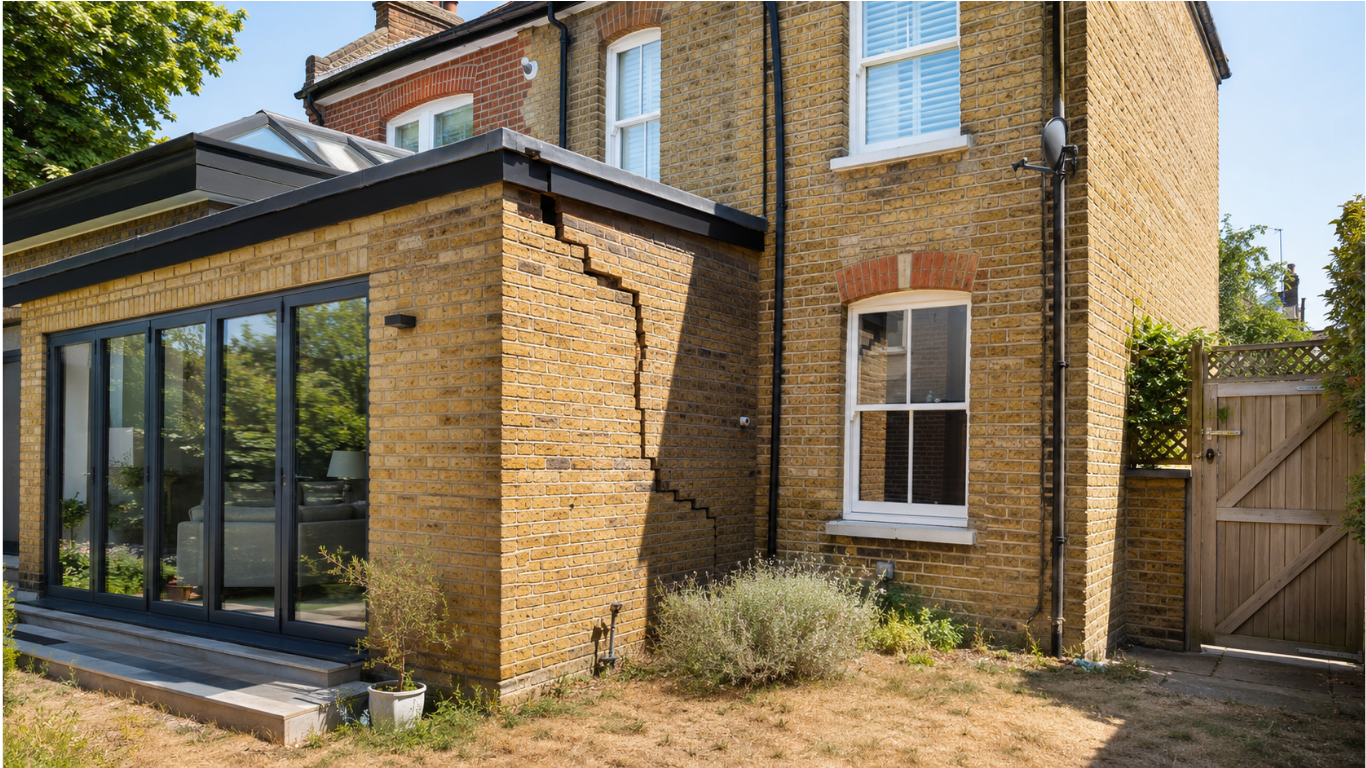
A large part of London is built on clay-rich ground, including the geological formation commonly known as London Clay.
This matters because clay can change volume as its moisture content changes. During prolonged dry weather it can shrink, while wetter conditions can cause it to swell.
For most properties this causes no significant problem. However, where foundations are shallow, drainage is defective, or large trees influence soil moisture, clay movement can contribute to subsidence, heave and cracking.
Is All of London Built on Clay?
No. It would be inaccurate to say that every London property sits directly on London Clay.
London's geology is complex and can include:
- London Clay
- River terrace deposits
- Alluvium
- Sands and gravels
- Chalk
- Made ground
Ground conditions can therefore vary significantly, even between properties located relatively close to each other.
What Is London Clay?
London Clay is a geological formation containing clay-rich material.
Some clay soils react strongly to changes in moisture. When they dry, they can shrink. When they become wetter, they can expand.
Dry clay can shrink → ground can move → foundations may move → cracking can occur.
The reverse can also happen. Where previously dry clay absorbs more moisture, it can expand. Excessive upward movement is known as heave.
Why Can Clay Cause Problems for London Houses?
The problem is rarely clay alone. Property movement normally results from several factors working together.
- The shrinkability of the soil
- Foundation depth
- The age and construction of the property
- Prolonged low rainfall
- High temperatures
- Nearby trees and shrubs
- Damaged drainage
- Extensions or conservatories with different foundations
A house built on clay is therefore not automatically a subsidence risk.
Why Are Trees Important on London Clay?
Trees extract water from the soil through their root systems.
During a prolonged dry period, mature trees growing close to buildings can contribute to further moisture loss from shrinkable clay.
Clay soil + prolonged drought + high temperatures + water-demanding trees = increased potential for ground movement.
However, homeowners should not assume that a nearby tree is automatically responsible for cracking.
Should You Remove a Tree Near a House Built on Clay?
Not without appropriate professional advice.
Removing a mature tree can significantly change moisture levels within clay soil. If the soil has been dried by the tree for many years, removal may allow the clay to rehydrate and expand.
In some circumstances this can contribute to heave.
Why Are Older London Houses Relevant?
London has a substantial stock of Victorian, Edwardian, inter-war and early post-war housing.
Older houses may have foundation construction that differs significantly from modern buildings.
This becomes particularly important when an older house has later additions such as:
- Rear extensions
- Side extensions
- Conservatories
- Porches
- Garage conversions
Different parts of the property may respond differently to ground movement.
Why Might an Extension Crack Away From the Main House?
An original house and a later extension may sit on different foundations.
If the clay beneath one structure moves more than the clay beneath the other, cracking can develop at the junction.
This is known as differential movement.
It does not automatically mean the entire house is subsiding.
Does Hot Weather Increase Subsidence Risk?
Potentially, yes.
Prolonged dry and hot conditions can reduce moisture in shrinkable clay, increasing the potential for ground movement.
However, one hot day does not suddenly cause a building to subside. Soil moisture is influenced over much longer periods.
Is Climate Change Increasing London's Subsidence Risk?
Research from the British Geological Survey indicates that warmer and drier summers may increase shrink-swell susceptibility in parts of London.
This does not mean every property will suffer subsidence, but it does make ground conditions increasingly important for homeowners, buyers and developers.
What Are Possible Signs of Clay-Related Subsidence?
- New diagonal cracks
- Cracks around doors and windows
- Cracks visible internally and externally
- Cracks that continue to widen
- Doors suddenly sticking
- Distorted window frames
- Uneven or sloping floors
- Movement between different parts of a building
These symptoms do not prove subsidence. Professional investigation may be required.
Could the Drains Be Responsible?
Yes.
Defective underground drainage can alter the ground supporting a building and may contribute to structural movement.
A proper investigation may therefore include:
- CCTV drainage surveys
- Trial holes
- Foundation inspections
- Soil testing
- Crack monitoring
Should You Water Dry Clay Around Your Foundations?
No.
Homeowners should not deliberately soak the ground around their foundations in an attempt to reverse clay shrinkage.
Artificial watering can create uneven moisture conditions and may introduce further movement.
Do not use a hose or sprinkler as a DIY subsidence remedy.
Does a House on London Clay Need Deeper Foundations?
There is no single foundation depth that is suitable for every London property.
Foundation design can depend on:
- Soil shrinkability
- Nearby trees
- Expected mature tree height
- Distance from vegetation
- Structural loading
- Site-specific ground conditions
Where shrinkable clay and trees are present, deeper foundations may sometimes be required.
What Should Buyers Ask?
If you are buying a London property, sensible questions include:
- Has the property experienced structural movement?
- Has there ever been a subsidence insurance claim?
- Has the property been underpinned?
- Are structural reports available?
- Have major trees been removed?
- Have extensions been constructed?
- Are there drainage problems?
Does London Clay Reduce Property Value?
Not by itself.
Large parts of London are built on clay-rich ground.
What can affect marketability is an actual structural problem, particularly where movement is active, unexplained, poorly documented or difficult to insure.
Elite International Real Estate's View
The statement "London is built on clay" is broadly useful, but technically incomplete.
A more accurate explanation is:
Much of London is underlain by clay-rich geology, including London Clay, but ground conditions vary significantly across the capital.
Clay itself is not a defect.
The property risk comes from the interaction between:
Soil → Moisture → Vegetation → Foundations → Drainage → Building Construction
Where movement is suspected, Elite recommends:
Observe → Record → Investigate → Diagnose → Stabilise → Repair
Frequently Asked Questions
Is North London built on clay?
Significant parts of North London contain clay-rich geology, but ground conditions vary from location to location.
Does London Clay always cause subsidence?
No. Millions of properties stand successfully on clay soil. Problems occur where ground movement becomes sufficient to affect foundations.
Can you build an extension on London Clay?
Yes. Extensions are routinely constructed on clay. Foundation design should take account of the actual soil, nearby vegetation and site conditions.
Should I buy a house built on London Clay?
Clay geology alone is not normally a reason to reject a property. More important questions are whether there is evidence of active structural movement and whether any previous problem was properly investigated and repaired.
Technical Sources
This guidance has been prepared with reference to published information from the British Geological Survey, Royal Institution of Chartered Surveyors and NHBC.
Important: This article provides general property information and does not constitute structural engineering, geological, surveying, insurance or legal advice. Ground conditions vary between individual sites and professional advice should be obtained where appropriate.
About Elite International Real Estate
Elite International Real Estate Ltd is an independent UK estate agency and property consultancy established in 2006, advising homeowners, landlords, investors and developers across London and the wider UK property market.
Global reach, real results.
Established since 2006.